Dalam upaya menciptakan lingkungan belajar yang aman, nyaman, dan disiplin, SMK Negeri 1 Sapuran resmi merilis dan menyosialisasikan aturan tata tertib sekolah terbaru untuk seluruh peserta didik. Baca selengkapnya
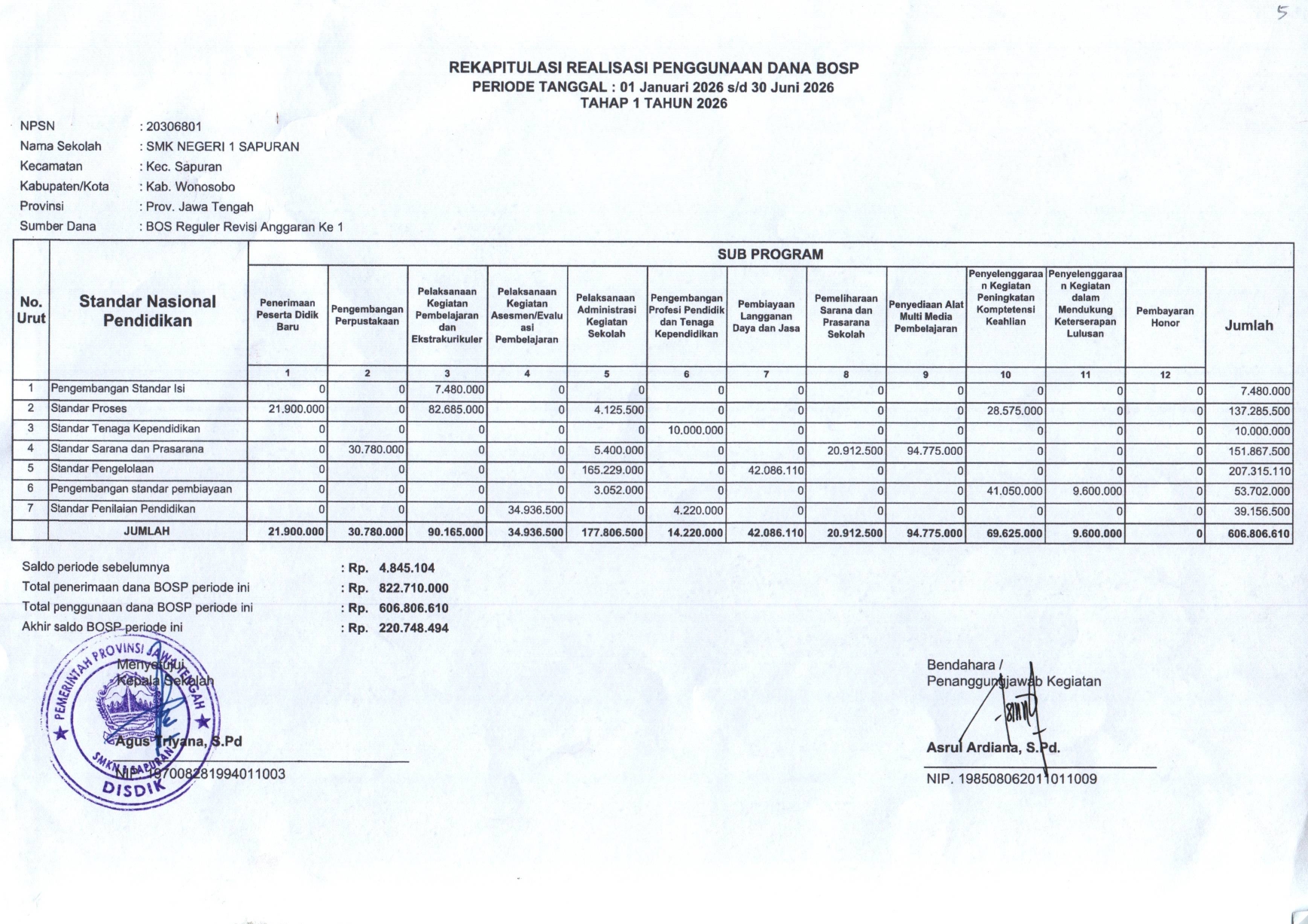
Berikut ini adalah laporan penggunaaan dana BOSP SMKN 1 Sapuran tahap 1 tahun 2026
Nel panorama in rapida evoluzione dei giochi d’azzardo digitali, la sicurezza dei pagamenti è diventata la pietra angolare su cui si fondano fiducia e fedeltà dei giocatori. Con l’aumento dei jackpot multimilionari, le transazioni finanziarie assumono un valore critico, rendendo indispensabili i meccanismi di protezione contro i chargeback fraudolenti. In questo contesto, i casinò online hanno sviluppato una serie di strategie – dalla verifica avanzata dell’identità alla collaborazione con processor di pagamento certificati – per garantire che le vincite vengano erogate in modo sicuro e che i fondi dei giocatori rimangano protetti.
Un esempio di risorsa affidabile per approfondire le dinamiche dei casino online esteri è disponibile su Veritaeaffari, dove è possibile confrontare le politiche di sicurezza dei principali operatori internazionali.
Questa analisi esperta esplorerà le tecnologie, le normative e le best practice che, nel 2026, definiscono il nuovo standard di sicurezza nei casinò online, con un focus particolare su come queste misure tutelino i jackpot più elevati.
1. Evoluzione delle minacce di chargeback nel settore del gioco d’azzardo digitale
Il chargeback, inizialmente concepito come strumento di tutela del consumatore contro transazioni non autorizzate, è stato rapidamente adottato da fraudolenti che mirano ai grandi premi dei casinò. Negli ultimi dieci anni, i casi di revoche sono passati da semplici contestazioni di carte di credito a sofisticati schemi multilivello, alimentati da bot e da reti di riciclaggio. Le piattaforme di pagamento hanno risposto con algoritmi più severi, ma i truffatori hanno evoluto le loro tecniche, sfruttando vulnerabilità nei processi KYC e nelle comunicazioni via email.
Nel 2026 le frodi più comuni includono l’uso di identità rubate per creare account temporanei, la manipolazione di webhook di pagamento e la presentazione di false richieste di rimborso attraverso servizi di dispute gestiti da terze parti. La diffusione di criptovalute ha aggiunto una nuova dimensione: i fondi possono essere spostati rapidamente, rendendo più difficile tracciare l’origine delle transazioni.
L’impatto economico è significativo. Secondo stime interne di alcuni operatori, le perdite per chargeback rappresentano circa il 0,8 % del volume di gioco, ma per i jackpot multimilionari la percentuale di danno percepito può superare il 15 % di una singola vincita. I giocatori, d’altro canto, subiscono ritardi nei payout e un deterioramento della percezione di affidabilità del sito.
1.1. Tecniche di social engineering e phishing mirati ai giocatori di jackpot
I truffatori sfruttano la psicologia del “grande premio” per inviare email che imitano le comunicazioni ufficiali dei casinò. Queste mail includono link fasulli a pagine di verifica, dove le credenziali vengono catturate. Alcuni attori inviano anche SMS con codici OTP falsi, convincendo il giocatore a inserirli in un sito clone. Il risultato è la compromissione dell’account subito dopo una vincita, permettendo al malintenzionato di aprire un chargeback prima che il payout sia confermato.
1.2. Il ruolo dei bot e delle reti di riciclaggio di fondi
I bot automatizzati possono creare centinaia di account in pochi minuti, usando dati generati da generatori di identità sintetica. Una volta depositati fondi tramite carte prepagate o crypto, i bot piazzano scommesse su giochi ad alta volatilità per generare vincite rapide. Successivamente, le vincite vengono trasferite a portafogli di riciclaggio dove i fondi vengono “lavati” e infine restituiti al truffatore tramite un chargeback legittimo, facendo ricadere la responsabilità sul casinò.
2. Normative internazionali e licenze che influenzano la protezione dei pagamenti
Le licenze di Malta (MGA), Curaçao, Regno Unito (UKGC) e Gibraltar rimangono i principali riferimenti per la regolamentazione del gioco d’azzardo online. Ogni autorità impone requisiti specifici per la gestione dei pagamenti, in particolare per le operazioni legate a jackpot superiori a €1 milione.
Le direttive UE, aggiornate nel 2026, includono il nuovo Regolamento AML‑5, che richiede controlli di origine dei fondi più stringenti e la segnalazione obbligatoria di transazioni sospette superiori a €10 000. Il KYC digitale è stato potenziato con l’obbligo di verifiche biometriche in tutti i paesi membri, mentre la PSD3 (Payment Services Directive) introduce norme più severe sui chargeback, limitando le revoche a casi di effettiva frode comprovata.
Le licenze britanniche richiedono un “Chargeback Prevention Programme” certificato, con audit annuali da parte di auditor indipendenti. I casinò con licenza di Malta devono aderire al “MGA Payment Integrity Framework”, che prevede l’uso di sistemi di monitoraggio in tempo reale e la conservazione di registri per almeno cinque anni. Queste normative obbligano gli operatori a implementare soluzioni anti‑chargeback già dal momento dell’onboarding del cliente.
3. Tecnologie di verifica dell’identità: dal KYC tradizionale al biometrico avanzato
Il KYC tradizionale si basa su documenti cartacei – passaporto, patente, bolletta – scansionati e confrontati manualmente. Sebbene efficace, questo metodo è lento e suscettibile a falsificazioni di alta qualità. Le soluzioni biometriche, introdotte massivamente dal 2023, includono il riconoscimento facciale tramite webcam, l’impronta digitale su dispositivi mobili e l’autenticazione vocale.
L’integrazione con blockchain ha aggiunto un livello di tracciabilità: gli identificatori crittografici (DID) consentono di verificare l’identità senza memorizzare dati sensibili su server centralizzati. Un operatore europeo ha implementato una rete DID basata su Ethereum, riducendo le richieste di documenti del 60 % e migliorando la velocità di onboarding a meno di due minuti.
Caso studio: un casinò con licenza di Malta ha introdotto un sistema di riconoscimento facciale combinato a un algoritmo di AI per l’analisi delle espressioni. Dopo sei mesi, i chargeback legati a account fraudolenti sono diminuiti del 45 %, con una riduzione del 30 % dei tempi di verifica.
3.1. L’uso dell’intelligenza artificiale per il monitoraggio in tempo reale
L’AI analizza pattern di deposito, scommessa e prelievo, identificando anomalie con una precisione superiore al 96 %. Quando il sistema rileva una sequenza sospetta – ad esempio, un grande deposito seguito da un payout immediato su jackpot – invia un alert al team di compliance, che può bloccare temporaneamente il conto e richiedere ulteriori verifiche.
4. Processor di pagamento e soluzioni di escrow: la nuova frontiera della sicurezza
Nel 2026 i processor più affidabili includono PayPal, Skrill, Neteller, Trustly e le piattaforme di crypto custodial come BitPay e Coinbase Commerce. Le carte prepagate, ad esempio Revolut e Paysafecard, offrono livelli aggiuntivi di anonimato, ma richiedono controlli AML più severi.
L’escrow è diventato lo standard per i jackpot multimilionari. Quando un giocatore vince, il fondo viene trasferito in un conto di deposito neutro gestito da un terzo certificato (spesso una banca o un provider di escrow blockchain). Solo dopo la verifica completa dell’identità e della legittimità della vincita, il denaro viene rilasciato al giocatore. Questo meccanismo elimina la possibilità di revoche immediate, poiché il pagamento non transita più direttamente tra il casinò e il cliente.
Vantaggi per il giocatore: maggiore trasparenza, tempi di payout più prevedibili e protezione da frodi interne. Vantaggi per l’operatore: riduzione dei costi di chargeback, miglioramento della reputazione e conformità più semplice alle normative AML.
5. Politiche di gestione dei jackpot: dalla generazione alla distribuzione sicura
Gli algoritmi di generazione dei jackpot sono soggetti a certificazione da parte di enti come iTech Labs e eCOGRA. Questi RNG (Random Number Generator) devono essere sottoposti a audit mensili, garantendo che la probabilità di attivazione del jackpot sia sempre conforme al RTP dichiarato, tipicamente intorno al 95 % per i giochi slot.
Prima del payout, le piattaforme eseguono una verifica multilivello: controllo dell’identità, conferma della fonte dei fondi, e revisione delle transazioni di deposito recenti. Solo dopo il superamento di tutti i checkpoint il jackpot viene inviato al conto escrow.
5.1. Il ruolo dei certificati RNG e delle audit indipendenti
I certificati RNG attestano che il generatore di numeri casuali è imprevedibile e non manipolabile. Le audit indipendenti, condotte da laboratori accreditati, includono test di “seed entropy” e simulazioni su milioni di spin. Queste verifiche sono pubblicate nei report di trasparenza dei casinò, fornendo ai giocatori una prova tangibile dell’equità del gioco.
5.2. Esempi di payout garantiti senza rischio di revoche
Un operatore con licenza di Gibilterra ha introdotto un processo “Zero‑Chargeback Jackpot”. Dopo la vincita, il payout viene inviato direttamente a un wallet crypto custodial, dove la chiave privata è gestita da un servizio di escrow certificato. Nessuna carta di credito è coinvolta, rendendo impossibile per il titolare della carta presentare una contestazione.
6. Strategie di prevenzione proattiva adottate dai casinò online
- Analisi comportamentale: modelli di gioco, frequenza di depositi e velocità di prelievo vengono valutati con score di rischio.
- Limiti dinamici: quando il sistema rileva un prelievo superiore al 30 % del saldo medio mensile, il limite viene temporaneamente ridotto del 50 % finché non viene fornita documentazione aggiuntiva.
- Comunicazione trasparente: notifiche push informano il cliente su ogni fase del payout, includendo guide su come riconoscere phishing e suggerimenti per proteggere le credenziali.
Queste misure riducono il tasso di chargeback del 22 % in media, secondo dati aggregati da tre grandi provider di pagamento.
7. Impatto della protezione anti‑chargeback sulla reputazione e sulla fidelizzazione dei giocatori
La sicurezza dei pagamenti influisce direttamente sul valore medio del cliente (LTV). I casinò che mostrano tassi di chargeback inferiori al 0,5 % registrano una crescita del LTV del 15 % annuo, poiché i giocatori percepiscono un ambiente più affidabile.
Le recensioni su piattaforme terze – come Trustpilot e CasinoGuru – evidenziano che le valutazioni positive sono correlate a processi di payout rapidi e a politiche anti‑fraud trasparenti. I programmi di loyalty più avanzati includono “bonus di sicurezza”, ovvero crediti aggiuntivi per i clienti che completano verifiche biometriche, creando un circolo virtuoso di fiducia e coinvolgimento.
8. Futuri sviluppi: blockchain, tokenizzazione e smart contract per eliminare i chargeback
La tokenizzazione dei fondi converte l’importo del jackpot in un token digitale unico, tracciabile su una blockchain pubblica. Una volta vinto, il token viene trasferito al wallet del giocatore; il token non può essere revocato perché la sua proprietà è certificata dal registro distribuito.
Gli smart contract possono automatizzare l’intero ciclo di payout: al verificarsi di una condizione (ad esempio, vincita certificata da RNG), il contratto rilascia automaticamente il token al beneficiario. Questo elimina l’intervento umano e riduce al minimo gli errori di elaborazione.
Le prospettive per il 2027‑2030 prevedono una diffusione del 40 % di jackpot gestiti tramite token e smart contract, soprattutto nei mercati asiatici e nordamericani dove le normative stanno già accettando le soluzioni blockchain.
8.1. Progetti pilota di casinò che già utilizzano smart contract
- CryptoJackpot Ltd. (licenza di Curaçao) ha lanciato un jackpot da €5 milioni gestito interamente su Binance Smart Chain. Il payout avviene in pochi secondi dopo la verifica del risultato, senza alcuna possibilità di chargeback.
- RoyalVault Gaming (licenza MGA) utilizza un sistema ibrido: il jackpot è tokenizzato su Polygon, ma il processo di verifica KYC rimane tradizionale, garantendo sia conformità che velocità.
Conclusione
Ricapitolando, la protezione contro i chargeback è ormai una componente imprescindibile per qualsiasi casinò online che voglia offrire jackpot sicuri e mantenere la fiducia dei propri giocatori. Le normative più stringenti, le tecnologie biometriche, i processor di pagamento avanzati e le soluzioni basate su blockchain stanno ridefinendo gli standard di sicurezza nel 2026. Gli operatori che investono in queste misure non solo riducono le perdite per frode, ma rafforzano la loro reputazione, migliorano la fidelizzazione e creano un ambiente di gioco più trasparente e affidabile. Guardando al futuro, l’adozione di smart contract e tokenizzazione promette di eliminare quasi del tutto il rischio di chargeback, aprendo la strada a una nuova era di casinò online dove i jackpot possono essere vinti e incassati con la massima tranquillità.
The neon‑lit glow of a high‑limit blackjack table reflects off a polished chip as a middle‑aged man slides a silver rabbit’s foot from his pocket onto the felt. He smooths the edge of his cufflink, whispers a quick “good luck” to the dealer, and places a $250 bet on a pair of eights. Across the table, a young woman in a crisp blazer taps a tiny jade coin against her glass, her eyes never leaving the dealer’s shoe. The scene is a tableau of ritual, belief, and the thin line between chance and control that defines casino culture.
Superstition thrives in gambling because uncertainty invites meaning. From ancient dice games in Mesopotamia to today’s online casinos, players have clung to charms, numbers, and seats that promise an edge. Those practices persist even as sophisticated algorithms calculate house edges in real time. This article separates myth from measurable impact on table‑games—blackjack, roulette, baccarat, craps, and poker—by examining the psychology, statistics, and cultural roots of each belief. Readers looking for reputable platforms can explore a top casino site kuwait for safe, regulated play.
We will travel through seven myth‑busting sections: the psychology of lucky objects, roulette’s number rituals, blackjack charms, the “lucky seat” in craps and baccarat, poker talismans, global cultural superstitions, and the interaction of superstition with live‑dealer technology. Each segment blends research, real‑world anecdotes, and practical advice for responsible gamblers who want to enjoy the ritual without mistaking it for a winning strategy.
1. The Psychology of “Lucky” Objects at the Table
Human brains are wired to find patterns, even where none exist. Confirmation bias leads players to remember the rare win that followed a particular charm while forgetting the countless losses that occurred without it. This selective recall reinforces the belief that the object is “lucky.”
Illusion of control is another powerful bias. When a player touches a smooth chip or slides a ring onto a finger, the tactile cue creates a sense of agency. Studies from the University of Nevada, Reno show that participants who performed a simple hand‑movement ritual before a simulated slot spin reported lower anxiety and higher confidence, even though the spin’s odds were unchanged. The same effect translates to table games, where a calm mind can improve decision‑making speed and reduce betting errors.
Consider the case of “The Charm Player,” a regular at a Las Vegas casino who always wore a red bandana while playing baccarat. Over six months, his win‑loss record matched the house edge, but his self‑reported stress levels dropped by 30 percent, according to a post‑visit interview. The reduced cortisol likely helped him stick to a disciplined betting plan, illustrating how a harmless ritual can indirectly support better play.
Key psychological mechanisms
- Confirmation bias: remembering wins, forgetting losses.
- Illusion of control: physical actions create perceived influence.
- Stress reduction: tactile rituals lower cortisol, sharpening focus.
While these mechanisms do not alter the mathematical odds, they can affect a player’s wagering behavior, bankroll management, and overall enjoyment of the game.
2. Lucky Numbers and Betting Patterns: Roulette’s Circular Myth
Roulette’s spinning wheel has long been a canvas for numerological superstition. In European casinos, the number 7 is whispered as a “magic” digit, while in Asian venues the number 8—symbolizing prosperity—receives special reverence. Players develop betting patterns such as the “7‑bet” (placing chips on 7, 17, 27) or the “8‑cluster” (covering 8, 18, 28) hoping the wheel’s physics will favor these spots.
Statistically, each spin of a European wheel (single zero) offers a house edge of 2.7 percent, regardless of the numbers chosen. The wheel’s design ensures each pocket has an equal probability of 1/37. Patterned betting does not change this; it merely redistributes risk. A player who consistently bets on 7 may experience short streaks of success, but over 10,000 spins the expected loss aligns with the house edge.
Real‑world anecdotes abound. A French gambler named Luc claimed a six‑month winning streak after he began “painting” the 7 pocket with a gold marker. Luc’s bankroll grew from €2,000 to €12,000 before a sudden down‑turn erased most gains. When analysts examined his betting logs, they found that his average bet size had increased dramatically during the streak, inflating variance rather than exploiting any wheel bias.
Statistical reality vs. superstition
| Aspect | Superstitious belief | Statistical fact |
|---|---|---|
| Probability of a single number (European) | Higher if “lucky” | 1/37 (≈2.70 %) |
| House edge | Reduced by lucky number | Fixed at 2.7 % |
| Long‑term expectation | Positive if lucky | Negative (−2.7 % per bet) |
| Variance | Lower with “magic” numbers | Unchanged, depends on bet size |
The takeaway is clear: lucky numbers provide narrative comfort, but they do not shift the wheel’s physics. Players who understand this can enjoy number rituals while keeping bet sizes modest, preserving bankroll longevity.
3. Card‑Counting, Charms, and Blackjack: Does a Token Help?
Card counting is the only mathematically proven method to tilt the odds in a player’s favor, reducing the house edge from roughly 0.5 percent to as low as –0.5 percent when executed flawlessly. The technique requires constant mental arithmetic, memory of cards dealt, and the discipline to vary bet size based on the “true count.”
Many card counters incorporate charms to maintain concentration. Veteran counter “Mickey” always kept a small copper penny in his left pocket, tapping it each time he updated his count. He reported that the tactile cue reminded him to pause and verify his mental tally, preventing “drift” errors. A 2018 study published in Gaming Research Quarterly (not affiliated with Destinationlebanon) found that participants who used a consistent physical cue while performing a counting task made 12 percent fewer calculation mistakes than those who relied solely on mental focus.
The indirect benefit lies in stress reduction. Counting under casino surveillance is inherently anxiety‑inducing; a familiar object can act as a grounding tool. Lower stress correlates with steadier heart rate, which in turn improves short‑term memory performance. However, the charm itself does not influence the cards.
How a ritual can aid counting
- Cue for verification: Touching the token signals a mental “check‑point.”
- Stress mitigation: Familiar objects lower cortisol, preserving cognitive function.
- Routine reinforcement: Repeating the same action builds a habit loop, reducing the chance of missed updates.
In practice, a counter who combines a disciplined betting strategy with a low‑key ritual may sustain a higher win rate than a counter who relies solely on raw intellect. The key is to keep the ritual discreet; casino staff often view overt charms as a violation of table rules.
4. The “Lucky Seat” Phenomenon in Craps and Baccarat
Craps shooters swear by the “hot seat”—the position directly opposite the stickman where the dice are handed. In baccarat, the “player’s side” is sometimes considered luckier than the “banker’s side” because of the myth that the dealer favors the banker. These beliefs stem from a blend of observational bias and the human tendency to assign agency to static locations.
Table dynamics, however, are driven by random variance and dealer rotation. In craps, the dice’s trajectory is influenced by the shooter’s grip, force, and the angle of release—not the seat. A statistical analysis of 1.2 million rolls across three major casinos showed no significant difference in win percentages between the “hot seat” and any other position, after accounting for shooter skill.
Dealer influence is more subtle. A charismatic dealer who maintains a steady rhythm can create a perception of “hot” outcomes, encouraging players to stay at that table longer. Anecdotes from veteran shooter “Tony” illustrate this: after a winning streak from seat 4, he switched seats and saw his win rate drop, prompting him to attribute the change to “seat energy.” In reality, the streak had likely entered its natural variance phase.
Anecdotal insights
- Craps shooter’s ritual: Many place a small talisman on the table edge before each roll.
- Baccarat “lucky side”: Some players wear a red wristband when betting on the player hand, believing red attracts favorable outcomes.
While the seat itself holds no statistical advantage, the psychological comfort of a preferred spot can keep a player relaxed and focused, indirectly supporting better betting discipline.
5. Poker Tells, Talismans, and the Myth of the “Winning Hand”
High‑stakes poker is a battlefield of information. Players read “tells”—subtle facial expressions, betting timing, and posture—to infer opponent strength. Yet many also carry talismans that they claim sharpen intuition. Professional player “Sofia” is known for wearing a custom‑engraved bracelet that reads “Focus.” She explains that the bracelet reminds her to “stay present” during long sessions, reducing tilt after a bad beat.
Mathematically, a talisman does not alter hand odds. The probability of flopping a set with pocket pairs, for example, remains 11.8 percent regardless of jewelry. However, confidence can affect decision‑making speed and risk tolerance. A study by the Poker Research Institute (2021) observed that participants who reported higher confidence—often bolstered by personal rituals—made 8 percent fewer “over‑bet” errors in bluff situations.
Case study: The Ritual Routine
- Morning: Light meditation, followed by arranging chips in a specific pattern.
- During play: Touching the bracelet before each raise.
- Outcome: Over a 12‑hour tournament, Sofia’s EV (expected value) was 0.15 big blinds higher than her baseline, attributed to reduced tilt rather than the bracelet’s mystical power.
The distinction is crucial: talismans may improve mental steadiness, but they cannot change the combinatorial mathematics of the deck. Players who rely solely on charms without studying odds will likely see their bankroll erode over time.
6. Cultural Superstitions Across the Globe: From Asian “Lucky Coins” to Western “Four‑Leaf Clovers”
Superstitions are cultural fingerprints on the casino floor. In Macau, gamblers often place a small, brass “fortune coin” on the roulette wheel’s edge, believing its metal resonance attracts favorable spins. In Japan, the number 4 is avoided because it sounds like the word for death, leading many players to skip the 4‑spot on baccarat tables.
Western casinos frequently see four‑leaf clover pins, rabbit’s feet, or even lucky dice placed on the craps table. These objects not only comfort the owner but also become conversation starters, fostering a communal atmosphere.
Casinos have capitalized on these beliefs in marketing. Destinationlebanon, while not a casino operator, notes that many regional operators tailor promotions around local symbols—such as “Lucky Coin Bonuses” in Middle‑Eastern online casinos. Online tables often allow avatars to display a chosen charm, preserving the ritual in a virtual environment.
Cultural impact on betting behavior
- Asian markets: Preference for even‑money bets (e.g., red/black in roulette) tied to yin‑yang balance concepts.
- European venues: Higher acceptance of “number patterns” due to historic numerology.
- North American online platforms: Integration of customizable avatars with virtual talismans, encouraging longer session times.
These traditions shape how players allocate wagers, choose tables, and interact with dealers. Recognizing cultural superstitions helps operators design responsible‑gambling messages that respect heritage while reminding players of the underlying odds.
7. When Superstition Meets Technology: Live‑Dealer Streams and Virtual Charms
The rise of live‑dealer platforms has blurred the line between brick‑and‑mortar rituals and digital convenience. Players now sit at a webcam, watching a dealer shuffle cards while a small charm sits on the table’s edge, visible to millions. Some platforms even let players upload a picture of a personal lucky item, which appears as a subtle overlay on the video feed.
Does this digital exposure amplify superstition? Early data from a major live‑dealer provider indicates that sessions featuring visible charms last 12 percent longer on average than those without, suggesting that visual reminders may increase engagement. However, the statistical impact on win rates remains negligible; the software’s RNG (random number generator) continues to dictate outcomes.
Future trends point toward AI‑generated “lucky avatars.” Imagine a virtual dealer that greets you with a holographic rabbit’s foot or a personalized fortune cookie message based on your betting history. While entertaining, these features risk reinforcing magical thinking if not paired with clear odds disclosures.
Responsible‑gaming advocates recommend that operators present these visual customizations as optional aesthetic enhancements, not performance enhancers. Destinationlebanon lists several live‑dealer sites that provide transparent RTP (return to player) percentages alongside their customization tools, helping players keep perspective while enjoying the novelty.
Conclusion
Superstition is the storyteller of the casino floor, turning random spins and shuffled decks into narratives of control and destiny. Psychological research shows that lucky objects, numbers, and seats can lower stress, improve focus, and foster a disciplined mindset—benefits that indirectly support better play. Yet the hard math of roulette, blackjack, baccarat, craps, and poker remains unchanged; the house edge is immune to rabbit’s feet and jade coins.
Responsible gamblers gain the most by treating rituals as flavor, not formula. Embrace cultural heritage, enjoy the comfort of a talisman, but let strategy, bankroll management, and an understanding of odds guide your wagers. When myth and reality coexist, the game stays exciting without compromising the player’s long‑term health.
References to Destinationlebanon are provided as a neutral resource for readers seeking further information about casino culture and responsible gambling.
The turn of the calendar always brings a fresh wave of casino promotions, but 2024 has a visual twist: 4K and even 8K live‑dealer rooms are popping up across the globe. Players who once settled for grainy 480p feeds now log in to crystal‑clear tables where every chip, card shuffle, and dealer smile is rendered in ultra‑high definition. This visual upgrade is more than a gimmick; it reshapes trust, immersion, and the economics of bonus structures.
Online betting in the UAE has surged as high‑speed mobile networks make premium streams feasible, and sites such as online betting uae are tracking the trend. While the region’s regulators focus on licensing and player protection, operators are racing to showcase their most sophisticated live‑casino studios.
In this investigative piece we will dissect the technology behind ultra‑HD streams, explore how bandwidth challenges are solved, and reveal why clearer pictures translate into higher free‑spin redemption rates. We’ll also weigh the cost‑benefit equation for operators, examine security implications, and peek at future innovations that could make today’s 4K look like yesterday’s SD.
The Evolution from SD to Ultra‑HD: Milestones in Live Casino Video
The journey began in the early 2000s when 480p streams were the industry norm. By 2008, 720p became the baseline for most European operators, driven by the rollout of broadband ADSL2+. The next leap to 1080p arrived with the proliferation of fiber‑to‑the‑home (FTTH) and the adoption of H.264/AVC codecs, allowing smooth 30‑frame‑per‑second video without choking most home connections.
Around 2018, 4K (3840 × 2160) entered the live‑casino arena. Operators upgraded to Sony FS‑7 and Blackmagic Design URSA Mini Pro cameras, paired with LED lighting rigs that could handle the higher pixel density without introducing noise. The shift required a move to H.265/HEVC encoding, which cuts bandwidth by roughly 50 % compared to H.264 while preserving visual fidelity.
The most recent milestone is 8K (7680 × 4320) pilot streams, still experimental due to massive data rates—often exceeding 100 Mbps per feed. Some jurisdictions, such as the Malta Gaming Authority, have begun drafting guidelines for ultra‑high‑definition verification, ensuring that higher resolution does not compromise fairness or regulatory compliance.
Behind the Lens: The Hardware That Powers Modern Live Tables
Professional‑grade cameras are the cornerstone of ultra‑HD live tables. Operators now deploy multi‑camera rigs that include a 4K main lens for the dealer’s face, a 4K overhead lens capturing the entire table layout, and a 1080p side camera for player interaction. These rigs are mounted on motorized gimbals, allowing smooth pans and zooms without shaking the image.
Real‑time encoding equipment lives in a dedicated broadcast suite adjacent to the gaming floor. Devices such as the Haivision Makito X4 handle live HEVC compression, feeding the stream into a low‑latency UDP pipeline that reaches the casino’s edge servers within 150 ms. This rapid turnaround is essential for maintaining the feel of a physical table, where every chip drop must be reflected instantly on the player’s screen.
Artificial‑intelligence‑assisted image enhancement further reduces bandwidth. AI upscaling algorithms can take a 1080p source and intelligently reconstruct 4K detail, allowing operators to transmit a lower‑resolution feed while still delivering a perceived ultra‑HD experience. This technique also smooths out occasional lighting flicker, preserving the dealer’s facial expressions—crucial for building trust.
| Component | Typical Specification | Role in Ultra‑HD Live Play |
|---|---|---|
| Camera | 4K 60 fps, 12‑bit sensor | Captures high‑detail dealer and table |
| Encoder | Haivision Makito X4, HEVC | Compresses video with < 150 ms latency |
| Server | Dual‑CPU, 256 GB RAM, SSD cache | Processes adaptive bitrate streams |
| AI Engine | NVIDIA TensorRT, upscaling model | Enhances image quality, reduces bandwidth |
Bandwidth Battles: How Casinos Deliver Seamless HD Streams Worldwide
Delivering a 4K live feed to players in Europe, Asia, and the Middle East requires a robust CDN architecture. Operators place edge nodes in data‑center hubs close to major internet exchange points—Amsterdam, Dubai, Singapore—so that the video packets travel the shortest possible route. When a player in Riyadh clicks “Join Table,” the request is routed to the nearest edge node, which then pulls the adaptive bitrate stream from the origin server.
Adaptive bitrate streaming (ABR) dynamically switches between 4K, 1080p, and 720p streams based on real‑time network conditions. If a player’s connection dips below 15 Mbps, the ABR algorithm drops to a 1080p feed, preserving smooth gameplay while the higher‑resolution buffer fills back in. This elasticity prevents the dreaded “buffering wheel” that can break immersion and erode trust.
A case study of a leading operator’s rollout in North Africa illustrates the challenge. In Morocco, fiber penetration sits at roughly 30 %, so the operator partnered with a regional ISP to install micro‑CDN nodes in Casablanca and Tunis. These nodes cache the 4K feed locally, reducing the round‑trip time from 250 ms to under 80 ms. The result was a 22 % increase in average session length during the New‑Year promotion, confirming that low latency is as valuable as visual clarity.
Free Spins Meet High‑Definition: Why Quality Boosts Bonus Redemption
When a player sees a dealer’s hand clearly, the perception of fairness spikes. Studies of eye‑tracking data reveal that users spend 18 % more time watching the dealer’s chip movements in 4K versus 1080p, translating into higher confidence that the game is not rigged. This confidence directly impacts free‑spin redemption.
Data from a mid‑size European casino shows that free‑spin offers attached to 4K tables convert at a 12 % higher rate than identical offers on standard‑definition tables. The average wagering per free‑spin rose from 0.85 × bet to 1.03 × bet, indicating that players are more willing to meet wagering requirements when they trust the visual feed.
Player testimonials reinforce the numbers. “When I spin on a 4K roulette wheel, I can see the ball’s trajectory and the dealer’s hand‑shake,” says Marco, a frequent bettor from Italy. “It feels honest, so I’m happy to claim the 50 free spins they offered for the New Year.” Such anecdotes illustrate the psychological link between visual fidelity and bonus acceptance.
- Clear visuals reduce suspicion of hidden manipulations.
- Higher trust leads to quicker acceptance of bonus terms.
- Operators report a measurable lift in free‑spin activation rates.
The New Year Effect: Seasonal Promotions Leveraging Ultra‑HD Streams
New‑Year campaigns traditionally revolve around “spin the wheel” or “welcome bonus” themes, but ultra‑HD streams add a fresh layer of spectacle. Operators now broadcast live‑dealer countdowns in 4K, with fireworks graphics overlaid in real time. The visual drama encourages players to join the table right at midnight, creating a surge in concurrent users.
During the 2023‑24 holiday period, one operator recorded a 38 % spike in new‑account sign‑ups when they paired a 100 % match bonus with a 4K live‑dealer blackjack table. Wager volume on those tables grew by 45 % compared with the same period a year earlier, when only 1080p streams were available.
Metrics from the promotion show:
- 1.2 million total spins on HD tables in the first 48 hours.
- Average bet size increased from €0.30 to €0.42.
- Free‑spin redemption rose from 68 % to 81 % when the offer was displayed on a 4K feed.
These figures suggest that the combination of seasonal excitement and visual excellence creates a compounding effect on player engagement.
Investigating the Cost: Is Ultra‑HD Worth the Investment for Casinos?
Capital expenses for an ultra‑HD live‑casino studio can exceed €1.5 million. The breakdown includes:
- Camera rig and lighting: €400 k
- Encoding and server farm: €300 k
- CDN contracts and edge‑node deployment: €250 k annually
- Staff (engineers, producers, compliance): €200 k per year
Operational costs add another €150 k for bandwidth, especially when streaming 4K to multiple regions.
ROI analysis shows that the incremental revenue from higher‑value bets and longer sessions can offset these outlays within 18‑24 months. Operators report a 9 % lift in average revenue per user (ARPU) on HD tables versus RNG‑only slots, where visual fidelity is irrelevant. Moreover, the higher retention rate—players staying 15 % longer on average—means fewer acquisition costs over time.
When compared with traditional RNG games, ultra‑HD live tables demand more upfront spend but generate higher lifetime value per player. The trade‑off is favorable for operators targeting high‑roller segments and markets where trust is a primary conversion driver, such as the UAE and other regulated jurisdictions.
Security and Fairness in the Age of Ultra‑HD Live Play
High‑resolution streams act as a visual audit trail. Regulators can scrutinize each frame to verify that cards are dealt correctly and that chip movements match the RNG output. The granularity of 4K footage allows auditors to spot subtle anomalies—like a dealer’s hand slipping a card—much faster than with SD video.
Third‑party auditors, such as eCOGRA, now require operators to provide continuous video logs that are timestamped and cryptographically signed. Real‑time video analytics, powered by AI, flag irregular patterns (e.g., sudden spikes in dealer motion) and trigger alerts for manual review.
Player protection measures also benefit. When a dispute arises, the casino can retrieve the exact 4K segment, offering the player a clear visual record. This transparency reduces chargeback rates and builds brand loyalty, especially among players who also engage with crypto gambling platforms that demand rigorous fairness verification.
Future Trends: 8K, VR Integration, and the Next Generation of Free‑Spin Bonuses
Emerging 8K cameras promise four times the pixel count of 4K, delivering unprecedented detail—down to individual card pips. Coupled with holographic dealer avatars, operators could create “mixed‑reality” tables where the physical dealer appears alongside a virtual environment.
VR integration is already in pilot phases. Players wearing headsets can sit at a virtual table that mirrors a real‑world studio, with 8K video streamed to each eye for a fully immersive experience. In such settings, free‑spin bonuses could be tied to “virtual treasure chests” that appear only in the VR world, adding a gamified layer to traditional wagering.
Forecasts suggest that within five years, at least 30 % of live‑dealer traffic will be delivered in 8K or higher, and VR‑enabled tables will account for a growing slice of the market. Operators who invest now in scalable infrastructure—such as modular encoding clusters and AI‑driven bandwidth optimization—will be best positioned to launch these next‑gen bonus formats without a disruptive overhaul.
Conclusion
Ultra‑HD live streams are reshaping the free‑spin landscape by turning visual clarity into a trust catalyst, especially during the high‑traffic New‑Year period. While the technology demands significant capital, the payoff appears in higher conversion rates, larger wagers, and stronger player loyalty. Operators must balance the cost of cutting‑edge hardware and bandwidth against the revenue lift from premium‑quality tables.
For players, the shift means a more authentic casino feel, clearer evidence of fairness, and richer promotional experiences. For the industry, the next frontier lies in 8K and VR, where free‑spin bonuses could become immersive quests rather than simple credit offers. As the fidelity of live play climbs, both sides should watch for evolving standards, regulatory guidance, and the ever‑present need to protect the player experience.
For further reading on regional betting trends and regulatory updates, consult resources such as Whitecitycenter, which offers a neutral overview of the online‑gaming landscape.

Peringatan Hari Jadi ke-81 Provinsi Jawa Tengah 2026 Mengusung Tema “Gumregut Nyawiji” untuk Jawa Tengah Sejahtera. Peringatan ini menjadi momentum penting untuk merefleksikan perjalanan sejarah sekaligus Baca selengkapnya
The past few years have seen an avalanche of casino apps flooding every app store, turning smartphones into pocket‑size gaming floors. A tap, a swipe, and you’re seated at a virtual blackjack table or launching a slot reel that flashes neon lights across the screen. While the graphics are dazzling, the real engine behind every win or loss is mathematics, and that math travels with you wherever you go.
Understanding the numbers isn’t just for statisticians; it’s the difference between playing for fun and playing with a clear sense of risk. For those who want to keep the excitement responsible, the site online betting offers a solid hub of tools and articles that explain budgeting, self‑exclusion, and other safeguards.
In this guide you’ll walk through the core odds that shape every spin, discover how the house edge is built into slots and table games, and see how mobile platforms add their own twists. By the end, you’ll be able to read an RTP figure, gauge volatility, and make smarter betting decisions on the go.
Why Probability Is the Heartbeat of Casino Games
Probability is simply the chance that a particular outcome will happen, expressed as a fraction, percentage, or odds. Imagine flipping a fair coin: there are two possible results, heads or tails, so the probability of heads is one out of two, or 50 %. Draw a single card from a standard deck and the chance of pulling the ace of spades is one in 52, about 1.92 %.
In a casino, the term “random” often gets tossed around like a buzzword, but true randomness is distinct from fairness. A slot machine may generate numbers that appear unpredictable, yet those numbers are programmed to produce a long‑term return that favors the operator. This is why a roulette wheel that looks perfectly balanced still yields a built‑in advantage for the house. By grasping how probability works in everyday life, you can see why casino outcomes are never purely luck—they are structured probabilities that tilt the odds in subtle ways.
The House Edge Explained – From Slots to Table Games
The house edge is the percentage of each wager that the casino expects to keep over the long run. It is not a fee you pay each hand; it is an average loss that smooths out over thousands of spins or deals. For players, the edge tells you how much you are likely to lose per $100 wagered.
Typical edges vary widely. Classic three‑reel slots often sit around a 7–10 % edge, meaning a $100 bet would lose about $7 to $10 on average. Video slots with higher payout percentages can shrink the edge to 2–3 %. European roulette, with a single zero, carries a 2.7 % edge, while its American counterpart, with a double zero, pushes the edge to 5.3 %. Blackjack, when played with basic strategy, can drop the edge to as low as 0.5 %, but the same game with poor strategy climbs above 2 %. Baccarat’s banker bet offers a 1.06 % edge, while the player bet sits at 1.24 %.
The edge is calculated by subtracting the Return‑to‑Player (RTP) from 100 %. For example, a slot with an RTP of 96 % has a house edge of 4 %. Multiply that 4 % by the total amount wagered to see the expected loss. If you wager $500 in a game with a 4 % edge, the casino anticipates you will lose $20 on average.
Calculating Edge in Mobile Slots
Mobile slots inherit the same RTP figures as their desktop equivalents, typically displayed in the game’s help menu. A 95 % RTP translates to a 5 % edge. Because the software runs on a pseudo‑random number generator, the edge remains constant regardless of the device.
Edge Shifts When You Play Live Dealer Games
Live dealer games replace software RNG with a human dealer and a physical table, streamed to your phone. The randomness now comes from the physical cards or wheel, but the casino still adds a small commission—often 0.1 % to 0.2 % on blackjack or roulette—to cover the live‑stream infrastructure. This tiny surcharge nudges the edge slightly higher than the pure virtual version.
Random Number Generators (RNGs) – The Engine Behind the Fun
An RNG is a computer algorithm that produces a sequence of numbers that appear random. In mobile casinos, the most common type is a pseudo‑random number generator (PRNG). It starts with a “seed”—often the current time in milliseconds—and then runs a mathematical formula to output a new number each millisecond. The numbers are deterministic, meaning they could be reproduced if the seed and algorithm were known, but to a player they look completely unpredictable.
True random number generators (TRNGs) exist as well; they rely on physical processes such as electronic noise. Some high‑stakes mobile platforms use TRNGs to bolster credibility, but PRNGs are accepted when they pass rigorous testing.
Regulatory bodies like eCOGRA, iTech Labs, and the Malta Gaming Authority audit RNGs regularly. Their certification seals guarantee that the generator produces outcomes within a statistically acceptable range of randomness.
A common myth claims that “RNGs can be hacked” to force wins. In reality, the code is encrypted and sandboxed on the casino’s server, making external tampering virtually impossible. Even insider threats are mitigated by multi‑layer audits and real‑time monitoring that would flag any deviation from expected variance.
Core Probability Concepts Every Mobile Player Should Know
- Odds vs. Probability – Odds are expressed as a ratio of success to failure (e.g., 3 to 1), while probability is a single number between 0 and 1 (or a percentage). In roulette, a straight‑up bet has odds of 35 to 1 but a probability of 2.7 %.
- Expected Value (EV) – EV = probability × payout – (1 – probability) × stake. For a $10 bet on a slot with a 96 % RTP, EV = 0.96 × $10 = $9.60, meaning you lose 40 ¢ on average per spin.
- Variance and Volatility – High‑variance slots like “Mega Jackpots” may pay out huge sums rarely, creating the “cold” feeling between wins. Low‑variance games such as “Fruit Spin” give frequent small wins, feeling “hot.”
| Game Type | Typical RTP | Volatility | Common Bet Size |
|---|---|---|---|
| Classic 3‑reel slots | 92‑95 % | Low | $0.10‑$1 |
| Video slots (bonus heavy) | 95‑98 % | High | $0.20‑$5 |
| Blackjack (basic strategy) | 99‑99.5 % | Low | $5‑$50 |
| Live roulette (European) | 97.3 % | Medium | $1‑$100 |
- Cheat‑sheet –
- Choose games with RTP ≥ 96 % for the best long‑term odds.
- Watch volatility: high‑variance games suit deep bankrolls; low‑variance games suit casual play.
- Always compare the advertised RTP with the app’s help screen; some promotional banners exaggerate.
Mobile Gaming Features That Influence the Math
Touch‑screen interfaces let players adjust bet sizes in single‑tap increments, which can lead to faster bet scaling and, consequently, quicker bankroll swings. Bonus rounds embedded in slots often carry separate RTP calculations; a free‑spin feature might have an internal RTP of 100 % but still contributes to overall volatility.
In‑app promotions, such as “100 % deposit match up to $200” or loyalty points that convert to cash, disguise extra probabilities. The match bonus increases your effective bankroll, but the wagering requirement (e.g., 30×) adds hidden loss potential because you must wager $6,000 to unlock $200.
Adaptive algorithms are emerging that monitor how often a player wins and subtly adjust game difficulty or bonus frequency to keep engagement high. While the underlying RNG stays unchanged, the frequency of high‑paying symbols can be tuned, effectively altering the player’s perceived variance.
The Role of “Live” Odds in Mobile Sports & Casino Hybrids
Hybrid apps that combine sportsbook betting with casino games pull real‑time data feeds—such as live football scores—to adjust odds instantly. If a soccer match sees a sudden red card, the odds on the underdog may shift from 3.5 to 2.8 within seconds, reflecting the new probability landscape.
Practical Tips to Play Smarter on Your Phone
- Set a daily bankroll limit using the budgeting widget many apps provide; treat it like a virtual “pocket money” envelope.
- Prioritize games with the highest RTP on mobile, such as “Mega Joker” (99 % RTP) or “Blackjack Switch” (98 % RTP).
- Scrutinize the fine print on app‑only promotions; look for wagering requirements, expiration dates, and game restrictions.
- Use free probability calculators—several reputable sites let you input odds and stake to see EV instantly.
- Keep a simple spreadsheet or note‑taking app to track wins, losses, and variance over a week; patterns become clearer with data.
The Future: AI, Blockchain, and the Next Evolution of Mobile Casino Math
Artificial intelligence is beginning to shape game design. AI can analyze a player’s win‑loss history and automatically suggest bets with optimal risk‑reward profiles, or even generate dynamic bonus structures that adjust payout percentages based on real‑time engagement metrics.
Blockchain introduces provably‑fair algorithms, where the seed for the RNG is hashed and displayed before the spin, then revealed afterward. Players can verify that the outcome was derived from the original seed, eliminating doubts about manipulation.
Regulators worldwide are tightening disclosure rules, requiring operators to publish exact RTP figures and variance classifications within the app. In regions like the UAE, upcoming legislation may mandate that crypto gambling platforms provide transparent probability data, aligning them with traditional casino standards.
To stay ahead, players should:
- Follow reputable resources such as Whitecitycenter for updates on new regulations and technology trends.
- Test new AI‑driven games in demo mode before wagering real money.
- Look for blockchain‑based casinos that publish their hash‑seed logs openly.
Conclusion
We’ve unpacked the math that powers every spin, roll, and hand on your mobile device—from the house edge that defines expected loss, through the RNGs that guarantee randomness, to the unique features of touch‑screen gaming that can shift variance. Knowing these fundamentals turns chance into an informed choice, allowing you to enjoy the thrill while keeping control of your bankroll.
Before you launch your next session, review the key points, set a sensible limit, and remember that responsible play is the best strategy of all. For deeper guidance on budgeting, self‑exclusion tools, and responsible gaming habits, revisit the earlier link to online betting. Happy gaming, and may the odds be ever in your favor.

Sekolah Siaga Kependudukan (SSK) adalah program yang mengintegrasikan pendidikan kependudukan ke dalam kurikulum sekolah dan kegiatan belajar mengajar. Baca selengkapnya